
Instructions for Patients
Undergoing
Perimetry
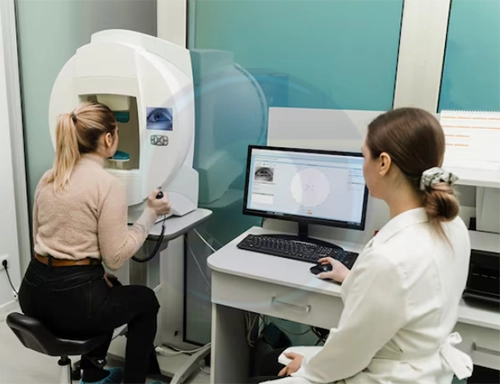
Perimetry is a test that maps your visual field and helps identify any areas where you
may have difficulty seeing. It’s an important tool for diagnosing and monitoring eye
conditions like glaucoma. Here’s what you need to know and do during the test:
Before the Test
Understand the Purpose:
- The test helps your eye doctor check your peripheral vision (the area you can see around you when you are looking straight ahead).
Be Prepared:
- If you wear glasses or contact lenses, bring them with you. You will need to wear them during the test.
- Try to relax. The test is non-invasive and doesn’t involve any pain.
During the Test
Getting Comfortable:
- You will be seated in front of the perimetry machine.
- Place your chin on the chin rest and your forehead against the forehead rest. This helps keep your head steady.
Using the Eye Patch:
- One eye will be covered with an eye patch. The test is done one eye at a time.
- Keep the uncovered eye focused on the central point.
Fixating on the Central Point:
- It is crucial to keep looking at the central point straight ahead throughout the test.
- Even when you see lights in your peripheral vision, do not look directly at them.
Responding to Lights:
- You will hold a button in your hand.
- Press the button every time you see a light, no matter how faint or where it appears in your vision.
- It's okay to miss some lights; just do your best to press the button whenever you see one.
Staying Focused:
- Try to keep your eye focused on the central point and stay as still as possible.
- The test can take several minutes. If you need a break or feel uncomfortable, et the technician know.
Switching Eyes:
- After testing one eye, the patch will be moved to the other eye.
- The process will be repeated for the other eye.
After the Test
Stay Calm and Relaxed:
- The test is straightforward and non-invasive.
Listen Carefully:
- Follow the instructions given by the technician.
Focus:
- Keep your gaze fixed on the central point, even if you see lights in your peripheral vision.
Respond Quickly:
- Press the button as soon as you see a light, but don’t worry if you miss some.
By following these instructions, you can help ensure that the perimetry test is accurate and provides useful information for your eye care.

QUICK LINKS
USEFUL LINKS
SANKALP HOSPITALS PVT. LTD.
Vijay Smruti, Town Hall Circle, Jamnagar - 361 001 (Gujarat) INDIA
sankalphospitals@gmail.com
0288 2553435
© 2024 Sankalp Hospitals Pvt. Ltd.